

Earthworks Biomat Private Limited - Brown Living™

Earthworks Biomat Private Limited

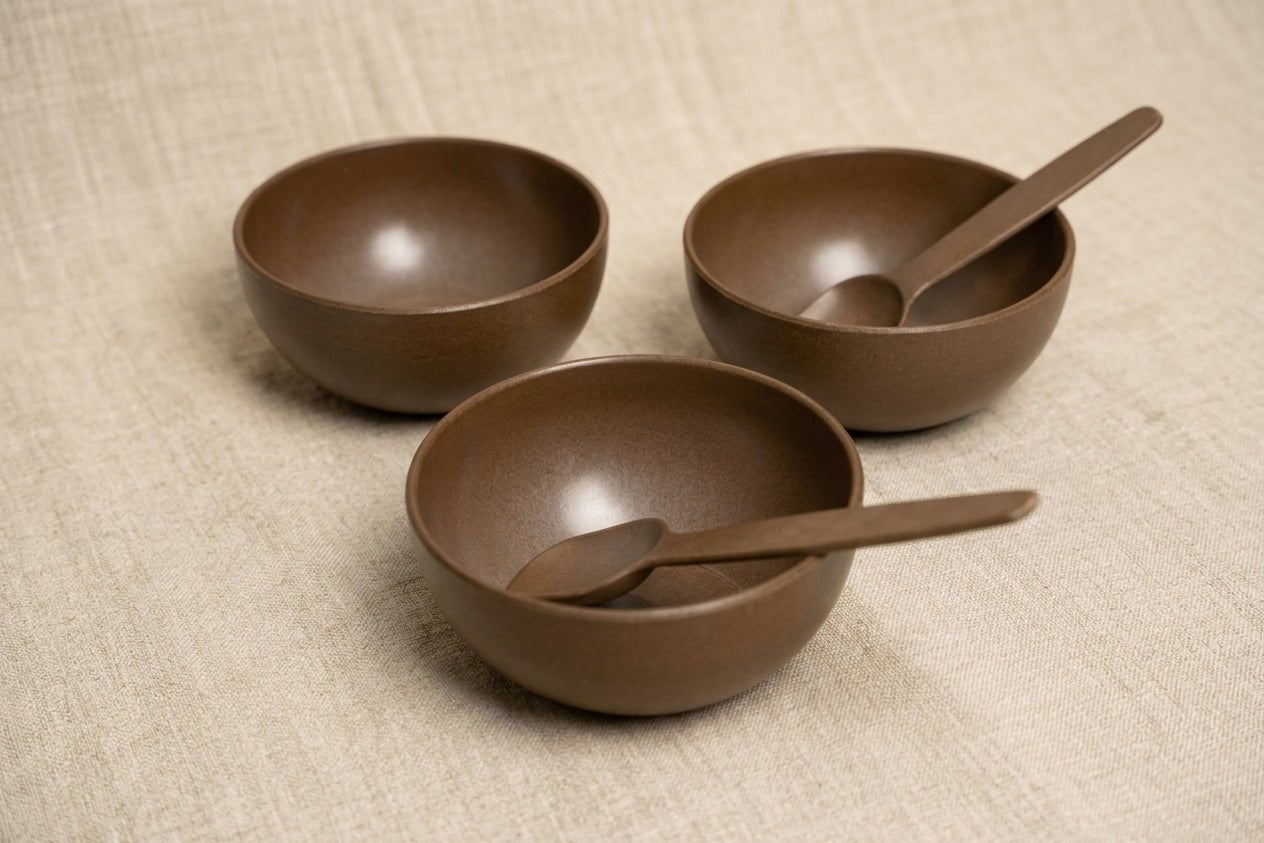
Earthworks is a sustainable materials innovation company redesigning inputs at the supply chain level. We bridge material science and manufacturing realities by turning agricultural residue— groundnut shells, bamboo residue, and other natural fibres—into high-performance materials in the form of granules and end-products like cutlery, protein scoops, luxury packaged goods, and more.


About Earthworks Biomat Private Limited

Earthworks Biomat Private Limited - Brown Living™

Earthworks was born from a fundamental design realisation: waste exists because materials and manufacturing systems were poorly designed in the first place. Founded by materials engineer Trupti Arabatti—backed by 15+ years of experience and mentorship from IISc Bangalore—we saw agricultural waste like jute fibre, areca husks, and bamboo residue being burned or landfilled while manufacturers relied on carbon-heavy fossil polymers. We set out to engineer a practical bridge. Earthworks transforms lignocellulosic biomass into patented, drop-in bio-composite granules (IN 202441095143). Our goal is to enable manufacturers to transition to lower-carbon, home-compostable materials seamlessly using their existing injection moulding and blow moulding infrastructure—with zero capital expenditure redesign. We exist to close loops on agricultural waste, restore supply chain traceability, and prove that industrial performance and circular material design can work as one.

Mission Statement

To enable zero-disruption circular transitions by engineering traceable bio-composites from waste.

Impact Created

Earthworks delivers quantifiable environmental and operational impact by targeting root systemic issues. By converting ligno-cellulosic agricultural biomass (jute, areca husks, bamboo) into high-performance industrial granules, we divert waste away from burning and landfilling—helping mitigate regional air quality crises and severe soil pollution. Our bio-composites feature a verified 30–40% lower carbon footprint than standard HDPE, reducing embodied carbon down to 1.647 kgCO2e/kg. At end-of-life, our materials offer home-compostable circularity, stopping persistent microplastics at the source. Simultaneously, we eliminate the primary adoption barrier for industrial sustainability. Our drop-in granules require no new tooling or factory redesign for B2B partners, enabling immediate carbon reductions across packaging, bottles, and molded products while offering full supply chain traceability from raw biomass to finished goods.

Overall employment created

6


% of Women Employees

90

Number of Artisans Empowered

0

What are the causes you support?

Carbon Neutral / Tree Plantations, Non-Toxic (No Toxic Chemicals Used), Upcycling Materials

What is the manufacturing process?

Earthworks uses a green chemistry method to extract the fibres and  proprietary reactive compounding, followed by conventional industrial manufacturing conversion: Agricultural residues and biomass are cleaned. We use our own green chemistry process to extract the cellulose and convert into pulverised into micro-fine powders, and strictly moisture-condition it (dried below 0.025% moisture) to prevent thermal degradation. The dried agro-filler is melt-blended with biopolymers and microbial polymers in an industrial machine. This ensures uniform chemical grafting and eliminates phase separation. Product Conversion: These granules are sent to standard industrial processing lines—primarily Injection Moulding (for rigid items like caps, cutlery, and containers) or Thermoforming/Extrusion—without requiring any specialised or custom machinery investments by the processor.

What are the ingredients/materials you use?

Earthworks formulates high-performance, petroleum-free bio-composites using a balanced multi-component architecture: High-purity agricultural waste streams (such as agro-fibres and cellulosic biomass) that reinforce the matrix and reduce reliance on virgin fossil plastics, and Biopolymers made from corn, sugarcane, microbial polymers and starch-based binders.

How do you source your raw materials/ ingredients?

Agricultural Waste / Biomass: Sourced locally and regionally through certified agricultural processors, farmer producer organisations (FPOs), and agricultural waste aggregators in Karnataka and neighbouring regions, ensuring a circular, low-carbon supply chain that prevents stubble burning/waste dumping. Biopolymers and binders: Sourced from certified global and domestic biopolymer / natural binders manufacturers, ensuring food-grade compliance, RoHS, and industrial safety standards.

During its life and beyond, can your products be repurposed or composted at home?

During its Life: The products behave exactly like conventional engineering plastics (HDPE/PP) in daily use—offering high tensile strength, moisture resistance, and durability during storage, transport, and consumer handling. • Repurposing & Mechanical Recycling: Unlike traditional multi-layer plastics that contaminate recycling streams, Earthworks' biocomposite granules can be mechanically reground, reprocessed, and recycled into lower-spec secondary goods. • End-of-Life (Composting): Industrial Composting: Fully designed to break down safely in industrial composting facilities under controlled temperature and microbial conditions (meeting international standards like EN 13432). Home Composting: Depending on the precise formulation architecture selected, Earthworks grades are engineered to degrade naturally in ambient soil or home-composting environments significantly faster than standard petroleum plastics, leaving behind no toxic microplastics or chemical residues.

Founded by Trupti Arabatti

Trupti is a materials engineer and sustainability innovator with over 15 years of experience across the materials science domain.